


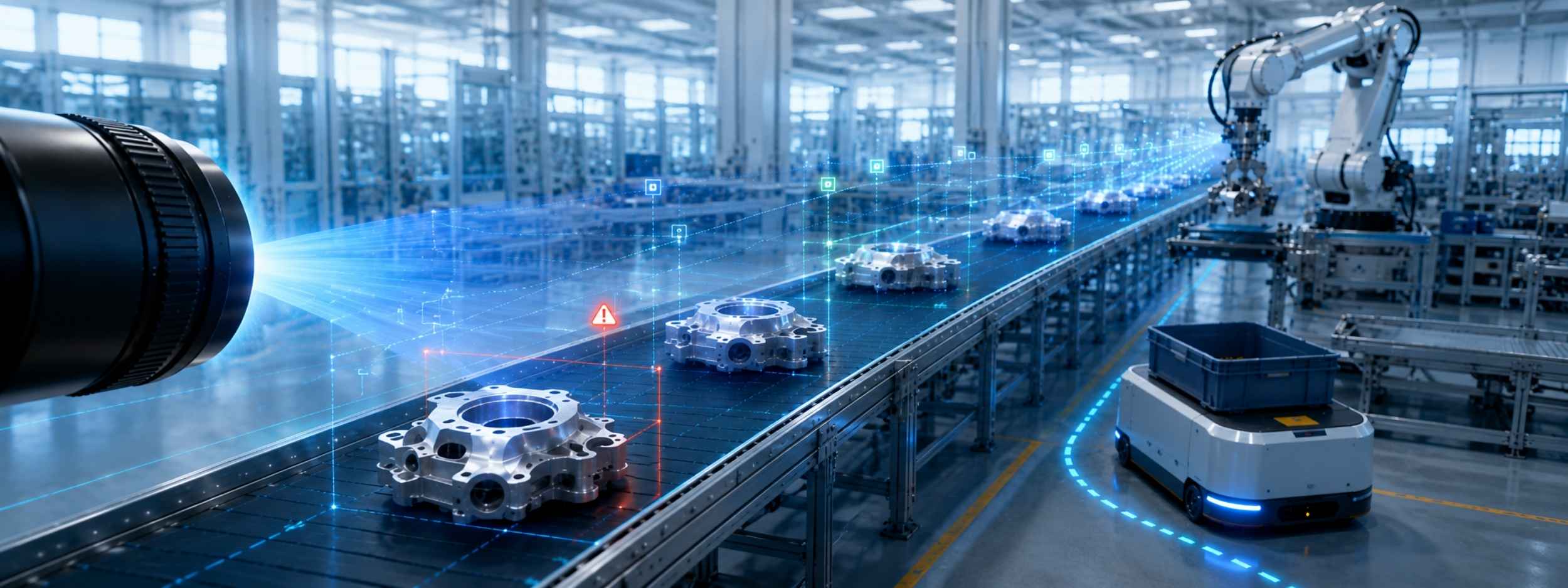


Physical AI is currently emerging as one of the most important future topics in industrial automation. While traditional machine vision systems capture and analyze information, Physical AI extends this approach by adding understanding, decision-making, and autonomous action. For machine builders, automation engineers, and production managers, this opens the door to a new generation of intelligent systems that not only see but actively respond to their environment.
Quick Overview
- Physical AI: Extends machine vision beyond image analysis by enabling autonomous decision-making and actions based on real-world situations.
- Perception Layer: Machine vision provides the image, depth, and motion data that Physical AI systems need to understand their environment.
- Key Applications: Autonomous mobile robots (AMRs), intelligent quality inspection, and adaptive manufacturing systems are among the leading use cases.
- Technology Foundation: Edge AI, GPU acceleration, and real-time processing enable Physical AI systems to analyze data and react directly at the point of operation.
- Future Potential: Physical AI is transforming machine vision from a tool for inspection into a foundation for autonomous, flexible, and self-optimizing industrial automation.
- What is Physical AI?
- Machine Vision as the Perception Layer of Physical AI
- Applications of Physical AI in Manufacturing
- Hardware Requirements for Physical AI Systems
- Role of Physical AI for Machine Builders and OEMs
- Physical AI at IMAGO Technologies
- Conclusion: Why Physical AI Is the Next Evolution of Machine Vision
- FAQs on Physical AI
What is Physical AI?
Physical AI describes the ability of intelligent systems to perceive, understand, and independently react to their physical environment. In industrial settings, this approach combines modern AI methods with sensors, robotics, and machine vision. The goal is to create machines that no longer make decisions solely based on predefined rules, but instead act according to the current situation in their environment.
The key difference lies in the connection between perception and action. While traditional systems capture and analyze information, Physical AI can derive specific actions from that information. This creates new opportunities for flexible and adaptive automation solutions.
Discover our systems
Build your Physical AI application on the right vision platform – from compact smart cameras to high-performance Edge AI systems.
From Computer Vision to Physical AI
Traditional machine vision primarily answers the question: “What do I see?” Systems inspect whether a component is present, a QR code can be read, or a product contains a defect. These tasks can be automated reliably and have been an established part of industrial manufacturing processes for many years.
Physical AI adds a layer of situational understanding to this perception capability. Instead of simply analyzing information, systems evaluate what they perceive and determine the next appropriate action. For example, a robot can independently identify the optimal grasping point for a component or adjust its trajectory in response to changing conditions.
As a result, machine vision evolves from a pure sensing technology into a central decision-making foundation for autonomous machines.
Why Physical AI Is Gaining Importance Now
Manufacturing environments are becoming increasingly dynamic. Companies are producing smaller batch sizes, offering more product variants, and must remain flexible to changing market demands. Under these conditions, traditional rule-based systems are increasingly reaching their limits.
Physical AI enables a much higher level of adaptability. Systems can evaluate unfamiliar situations and determine appropriate responses without relying solely on predefined rules. This creates significant value, particularly in applications involving variable products or dynamic production processes.
The growing adoption of human-robot collaboration is another factor driving the relevance of Physical AI. Machines must continuously interpret their surroundings and respond safely to changes in real time.


Machine Vision as the Perception Layer of Physical AI
For an autonomous system to make decisions, it requires accurate information about its environment. This is exactly the role of industrial machine vision. It provides the data needed for Physical AI systems to perceive and interpret the real world.
Machine vision serves as the perception layer of modern Physical AI applications. Without cameras and image processing, there is no foundation for autonomous decision-making and action. Advanced vision platforms such as AI vision cameras, AI smart cameras, and AI vision sensors capture and process the data required for intelligent automation. Combined with flexible image processing software such as ViewIT, they provide the technological foundation for Physical AI systems that can perceive, understand, and respond to their environment in real time.
What Information Modern Vision Systems Provide
Modern machine vision systems capture far more than traditional still images. In addition to high-resolution images, they can acquire video streams, depth information, and three-dimensional data models.
They can also analyze motion data, object positions, and spatial relationships between multiple objects. This creates a comprehensive digital representation of the real production environment.
Edge AI Computers
Industrial Edge AI computers combine high-performance processing, GPU acceleration, and machine vision connectivity in a rugged platform. They provide the foundation for Physical AI applications that require real-time decision-making, advanced AI models, and scalable computing performance directly at the machine.
These data form the foundation for intelligent decision-making. The more accurately a system can perceive its surroundings, the more reliably a Physical AI application can respond to changing conditions.
Why Traditional Machine Vision Alone Is No Longer Enough
Traditional vision systems are typically rule-based. When a specific feature is detected, a predefined action is triggered. This approach works extremely well for applications such as OCR, code reading, presence verification, and dimensional inspection.
However, modern manufacturing environments increasingly present situations that cannot be fully described by fixed rules. Products vary more widely, environments change, and processes become more complex.
Physical AI extends machine vision with adaptive decision-making capabilities. Systems can evaluate situations, consider probabilities, and select appropriate actions without requiring every possible scenario to be programmed in advance.

Sensor Fusion
Sensor fusion combines information from multiple sensors, such as cameras, depth sensors, and positioning systems. By merging different data sources, Physical AI systems gain a more complete understanding of their environment and can make more reliable decisions.
Typical Applications of Physical AI and Machine Vision
The combination of machine vision and Physical AI opens up a wide range of new opportunities in industrial automation. Significant benefits arise particularly in applications that require flexibility, adaptability, and autonomous decision-making.
Autonomous Mobile Robots (AMRs)
Autonomous mobile robots are increasingly taking over transport tasks in factories and logistics centers. To navigate safely, they must continuously perceive and interpret their surroundings. As a result, autonomous navigation is becoming increasingly important in logistics and factory automation environments.
Machine vision detects people, vehicles, obstacles, and free paths. Physical AI evaluates this information and determines the appropriate response.
By combining perception and action, autonomous navigation becomes possible. The robot can avoid obstacles, stop, or choose alternative routes without relying on external control.
Next-Generation Quality Inspection
Traditional machine vision detects defects and rejects faulty products. Physical AI extends this approach by providing a deeper understanding of process relationships and underlying causes.
For example, when an increasing scrap rate is detected, the system can investigate additional factors such as lighting issues, tool wear, or changes in machine parameters.
As a result, quality inspection evolves from a reactive to a proactive technology. Defects are not only detected, but their root causes can also be analyzed and appropriate corrective actions initiated.
Hardware Requirements for Physical AI Systems
Physical AI places new demands on industrial vision hardware. Autonomous systems must process large amounts of data, execute AI models efficiently, and support real-time decision-making. The following capabilities are particularly important for Physical AI applications:
Edge AI and GPU Acceleration |
Physical AI applications often require immediate responses to changing conditions. Processing data directly at the edge reduces latency and improves reliability. Powerful GPUs enable complex AI models to run directly within the production environment without relying on external computing resources. |
Real-Time Processing |
Autonomous systems must continuously perceive their environment and react without delay. Real-time image acquisition, processing, and communication ensure that decisions can be made quickly and reliably, even in dynamic situations. |
Scalability |
Physical AI projects frequently evolve over time. New algorithms, larger datasets, and additional functions must be integrated without redesigning the entire system. Scalable platforms provide the flexibility required for long-term development. |
Open Software Architectures |
Modern Physical AI solutions require seamless integration of vision, AI, robotics, and automation systems. Open software environments and standardized interfaces simplify integration and support future technology upgrades. |
Industrial Reliability |
Physical AI systems are often deployed in demanding industrial environments. Robust hardware, long-term availability, and stable operation are essential to ensure reliable performance in production and logistics applications. |
The Role of Physical AI for Machine Builders and OEMs
For machine builders, Physical AI fundamentally changes the requirements of system development. The focus shifts from individual components to intelligent, integrated systems.
From Individual Components to Intelligent Systems
In the past, projects primarily focused on selecting the right camera, lens, and software. Today, perception, AI, and action must be considered as a unified system.
The performance of a Physical AI solution depends on the interaction of all components. Autonomous functions can only be implemented reliably when machine vision, computing platforms, and AI technologies are seamlessly integrated.
New Requirements for Machine Development
OEMs increasingly require platforms that support both current and future AI workloads. Key requirements include real-time performance, GPU acceleration, and open development environments.
At the same time, demands on software integration and data processing continue to grow. Machines are evolving into intelligent systems that can continuously learn and adapt to changing conditions.
As a result, the ability to integrate Physical AI is becoming an important competitive advantage for machine builders and OEMs.
Build the Future of Industrial Automation
Enable machines to see, understand, and act. IMAGO vision platforms provide the performance, flexibility, and scalability needed for next-generation Physical AI applications.
Physical AI at IMAGO Technologies
The rise of Physical AI is driving the adoption of freely programmable vision platforms. These platforms provide the flexibility required to integrate new AI models and applications over the long term.
Vision Platforms for Physical AI Applications
High-performance systems such as the Vision Box AGE-X6 with Vision AI Xcelerix (available from September 2026), Vision Box AI, and Vision Box AGE-X5 provide the technological foundation for modern Physical AI applications.
Their high computing performance, GPU acceleration, and open software architectures enable complex AI workloads to run directly within industrial environments.
This flexibility is essential for applications that continuously evolve over time.
Flexible Embedded Vision and Smart Camera Systems
Compact platforms such as the Vision Cam XM2, Vision Cam LM2, and Vision Sensor PV4 also support advanced machine vision applications and can be seamlessly integrated into existing automation solutions.
Depending on the application, they enable scalable architectures ranging from traditional vision tasks to AI-powered analytics.
As a result, open vision platforms provide the foundation for future Physical AI solutions.
Conclusion: Why Physical AI Is the Next Evolution of Industrial Machine Vision
Physical AI will not replace industrial machine vision—it will extend and enhance it. Machine vision remains the foundation for perceiving the physical world and provides the data required for autonomous decision-making.
The key advancement lies in adding understanding, decision-making, and action. This enables systems that not only inspect and analyze, but also actively contribute to optimizing industrial processes.
The transition from “See and Inspect” to “See, Understand, and Act” marks the next stage in the evolution of industrial vision systems. Companies that embrace this development early will create the foundation for more flexible, efficient, and future-proof automation solutions.
FAQs on Physical AI
What is the difference between Machine Vision and Physical AI?
Machine vision focuses on the perception and analysis of visual information. Physical AI extends this approach by adding situational awareness and autonomous decision-making. While machine vision identifies what is happening, Physical AI also determines what action should be taken next.
Does Physical AI always require artificial intelligence?
Physical AI is typically based on AI technologies, but it goes beyond AI models alone. Autonomous reactions to real-world conditions are only possible through the combination of sensors, machine vision, decision logic, and actuators.
What role do cameras play in Physical AI systems?
Cameras form the primary perception layer of a Physical AI system. They provide images, depth information, and motion data that AI models use to make decisions. Without this data foundation, autonomous interaction with the environment would not be possible.
Can existing machine vision systems be upgraded for Physical AI?
In many cases, existing systems can be enhanced step by step. Key requirements include sufficient computing power, open software architectures, and suitable interfaces. Flexible vision platforms are particularly well suited for supporting the transition to Physical AI.