


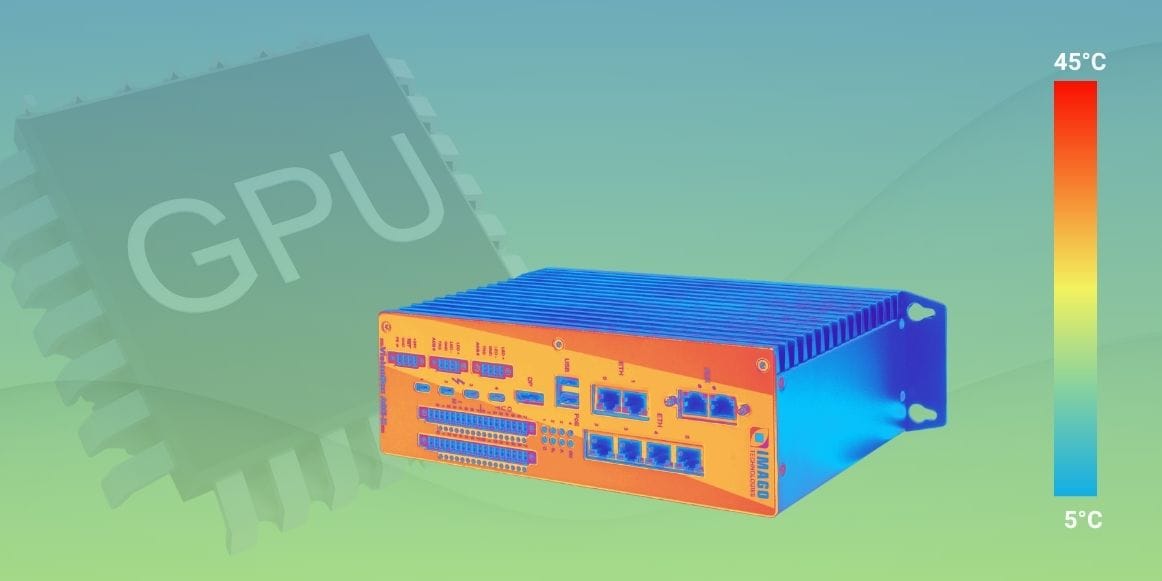


GPU expansion in industrial image processing refers to the use of highly compact, high-performance AI hardware directly within industrial processes. This development is transforming how vision systems are designed and integrated – shifting from centralized computing architectures to decentralized intelligence at the edge. For machine builders and system integrators, this creates the opportunity to execute AI-based decisions in real time directly within the machine.
At the same time, it becomes clear: deploying AI hardware alone is not sufficient. Only through targeted adaptation to industrial requirements does a solution emerge that operates reliably over the long term and delivers real added value.
Quick Overview
- Compact AI becomes industrial-ready – New hardware delivers high computing power directly inside machines.
- Edge AI enables real-time decisions – No latency from external infrastructure
- Thermal management determines stability – Cooling becomes a critical success factor.
- Smart cameras reduce integration complexity – compact systems combine camera, processor, and software for decentralized automation.
- Modular systems ensure future viability – Flexible integration enables scalable solutions.
- The Trend: GPU Expansion in Industrial Image Processing?
- The Challenge: Why GPU Expansion is not Automatically Industrial-Ready
- Thermal Management as as a Critical Success Factor
- Solution: GPU Expansion through Optimized Thermal Design
- Maximum Flexibility for Machine Builders and OEMs
- The Integrating High-Performance AI into Existing Systems
- Outlook: Scalable Edge AI in Industrial Image Processing
- FAQs on GPU Expansion in Industrial Image Processing
The Trend: GPU Expansion in Industrial Image Processing?
The rise of GPU expansion in industrial image processing is a direct result of increasing demands for speed, flexibility, and data availability. Modern GPU-based modules now deliver enormous computing power with minimal footprint, enabling entirely new system architectures.
In practical terms, this means: AI models can be executed exactly where the data is generated. This reduces latency and eliminates the need for external computing infrastructure. Especially in highly dynamic production environments, this represents a decisive advantage.
Typical use cases include:
• AI-based quality inspection directly in the machine
• Real-time classification and object detection
• Anomaly detection in ongoing processes
This development clearly shows: the future of industrial image processing lies at the edge – provided that systems are properly designed for it.
Discover Vision Systems
Find the right vision hardware for your application – compact, powerful, and flexible. Discover IMAGO Technologies solutions for industrial machine vision.
The Challenge: Why GPU Expansion Is Not Automatically Industrial-Ready
Despite its capabilities, most GPU expansion hardware is not inherently suitable for industrial environments. The challenge lies in operational reliability, not computational performance.
Consumer and development platforms are optimized for flexibility and rapid deployment. Industrial systems, however, must deliver consistent performance under continuous load and harsh conditions.
Typical Environments of Consumer AI
Typical Environments of Consumer GPU expansion are commonly designed for:
• development and testing environments
• laboratory applications
• temporary deployments
These environments operate under controlled conditions. Long-term stability and environmental robustness are not primary design considerations.
Limitations in 24/7 Industrial Operation
Industrial environments impose strict requirements. Systems must:
• operate reliably in continuous 24/7 conditions
• withstand elevated ambient temperatures
• function in enclosed industrial systems
Without adaptation, this leads to:
• thermal instability
• performance degradation due to throttling
• reduced hardware lifespan
The real challenge is not AI performance—but making it reliable in industrial use.

Thermal Management as a Critical Success Factor for GPU Expansion in Industrial Image Processing
When using GPU expansion in industrial image processing, thermal management becomes a central design parameter. As processing power increases, so does heat generation.
Industrial conditions intensify this issue. Limited airflow and closed environments make efficient heat dissipation difficult, increasing the risk of instability.
Why GPU-Based AI Is Thermally Critical
GPU-based systems generate high heat due to their high computational density. Continuous AI workloads further increase thermal stress.
This results in:
• constant heat generation
• no cooling cycles
• rising system temperatures over time
Impact of Insufficient Cooling on Performance and Lifetime
Inadequate thermal design directly impacts system performance:
• unstable AI outputs
• reduced performance due to throttling
• increased risk of failure
Over time, this significantly shortens hardware lifespan. Reliable industrial AI requires controlled thermal behavior.
The Solution: Industrializing GPU Expansion Through Optimized Thermal Design
To ensure reliable operation, Pocket AI in industrial image processing requires a holistic system approach. This includes computing power, cooling, integration, and long-term stability.
Only the combination of industrial hardware and targeted thermal management transforms AI capability into industrial reliability.
Active Cooling as an Enabler for Stable AI Performance
When integrating high-performance GPUs, passive cooling is often insufficient. Active cooling ensures stable thermal conditions under continuous load.
Key benefits:
• core temperature reduction (ΔTcore ≈ –30 °C)
• stable 24/7 performance
• improved system reliability
Thermal design is therefore the key enabler for industrial-grade GPU expansion.
From Consumer AI to Industrial Vision
The transition from consumer AI to industrial vision shifts the focus from performance to reliability. With proper integration, systems operate continuously, deliver consistent results, and integrate seamlessly into production—turning AI hardware into an industrial-ready solution.
Maximum Flexibility for Machine Builders and OEMs
Industrial applications require adaptable solutions. Flexibility in hardware integration is essential for long-term success.
Complete Solution: Validated Systems
Preconfigured systems offer:
• validated hardware components
• optimized thermal design
• fast deployment
This includes GPU expansion in the form of compact “Pocket AI” modules—pre-integrated and thermally validated for industrial use.
This approach minimizes integration effort and ensures reliability.
Bring Your Own AI: Open Platform Strategy
Alternatively, users can integrate their own GPU modules, enabling:
• maximum flexibility
• freedom of hardware choice
• long-term scalability
This modular approach aligns with long machine lifecycles.
Integrating High-Performance AI into Existing Systems
The integration of GPU expansion in industrial image processing enables companies to enhance existing systems without replacing their infrastructure. This approach reduces investment risks and allows for incremental AI adoption within established production environments.
Cost-Efficient System Upgrades |
Instead of developing new systems from scratch, existing machines can be expanded with AI capabilities. This significantly reduces capital expenditure while extending the lifecycle of current assets. |
Reduced Implementation Time |
Incremental integration avoids complex system overhauls. As a result, deployment times are shorter and AI applications can be brought into operation faster. |
Continuous Operation Without Disruption |
Upgrading existing systems ensures that production processes remain uninterrupted. Operational continuity is maintained while new AI functionalities are introduced step by step. |
Scalable AI Integration |
Modular system architectures allow flexible expansion of AI performance. Companies can scale their AI capabilities based on evolving requirements without redesigning entire systems. |


Outlook: Scalable Edge AI with GPU Expansion in Industrial Image Processing
Future industrial AI systems will require greater scalability. Flexible architectures will enable continuous performance upgrades without system replacement.
Developments include:
• integration of more powerful GPU modules
• expansion via external hardware
• scalable performance configurations
GPU expansion is becoming a core building block of future-ready production systems.
Conclusion: Why GPU Expansion in Industrial Image Processing Requires System Integration
GPU expansion in industrial image processing offers significant potential for efficiency, quality, and automation. However, only proper system integration unlocks this potential.
The decisive factor is not hardware alone, but its integration into a reliable system. Thermal management is the key enabler for long-term performance and stability.
Companies that adopt this approach create scalable, reliable, and future-proof AI solutions at the edge.
Increase Efficiency
Leverage powerful machine vision solutions that combine precision, speed, and scalability. IMAGO supports you with reliable technology for modern automation processes.
FAQs on GPU Expansion in Industrial Image Processing
Is GPU expansion suitable for continuous industrial operation?
GPU expansion is powerful but not inherently designed for 24/7 operation. Industrial use requires optimized thermal management and robust system integration to ensure long-term stability and performance.
Which applications benefit most from GPU expansion?
Applications requiring real-time processing and high data throughput benefit the most, including quality inspection, object detection, and anomaly detection.
What role does thermal management play in edge AI?
Thermal management is essential for stable edge AI systems. It prevents overheating, avoids performance throttling, and ensures consistent operation and long hardware lifespan.