


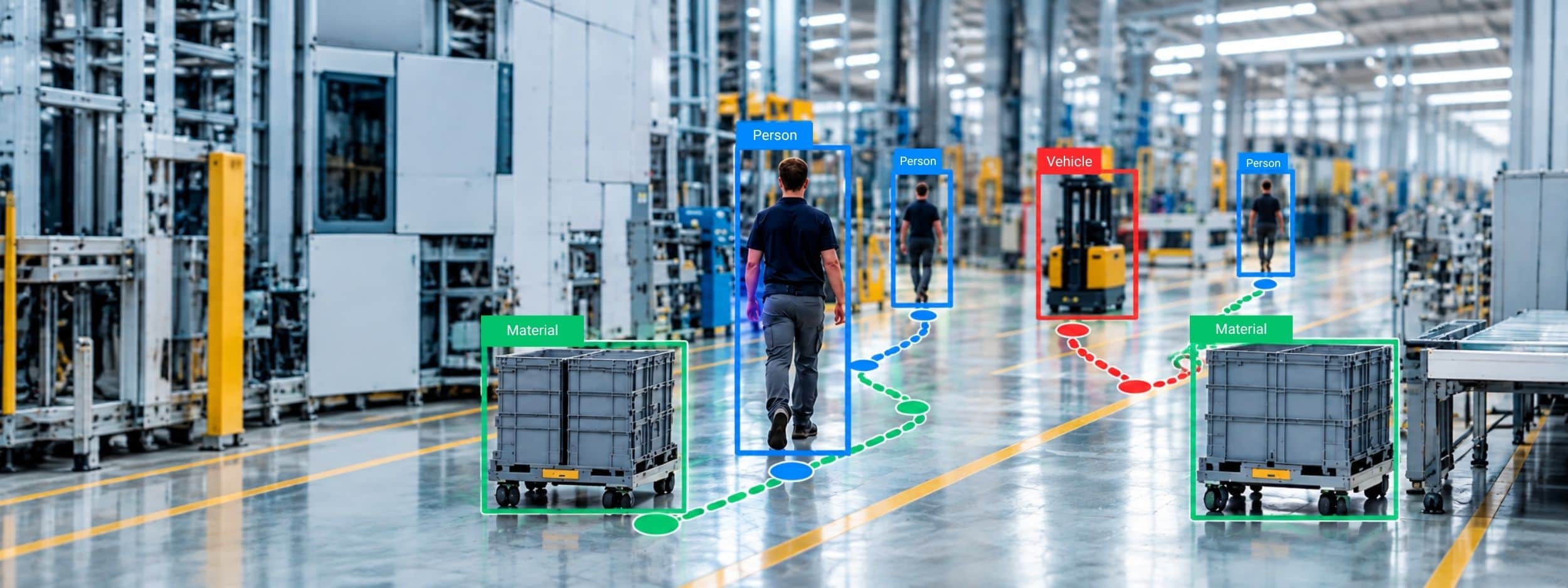


Material flow analysis creates transparency about what happens between machines and processes. It reveals how people, materials, and transport vehicles move through production and where waiting times or bottlenecks occur. Together with Fraunhofer IOSB-INA (Lemgo), IMAGO Technologies has developed a solution combining AI-based real-time localization with the open omlox standard. This enables companies to continuously capture and analyze material and process flows and identify potential for optimization.
Quick Overview
- Real-time material flow analysis: Movements of people, materials, and transport vehicles are continuously captured.
- AI directly on the camera: The Vision Cam XM2 detects and tracks people and objects directly on the device – without additional AI hardware.
- Open standard: Position data is standardized via omlox and made available to other systems.
- Objective process analysis: Heatmaps and digital spaghetti diagrams reveal routes, waiting times, and bottlenecks.
- Data privacy: Image processing takes place directly on the camera. Only abstracted position and movement data is transmitted externally.
- What Is Material Flow Analysis?
- Why Traditional Production Data Is Not Enough
- Material Flow Analysis with AI and omlox
- Why Embedded Vision Matters for Material Flow Analysis
- Capturing Material Flows in Real Time
- Spaghetti Diagrams for Material Flow Analysi
- Data Privacy in Camera-Based Material Flow Analysis
- What Are the Benefits of Continuous Material Flow Analysis?
- FAQs About Material Flow Analysis
What Is Material Flow Analysis?
Material flow analysis examines how materials, people, and transport vehicles move through production and logistics environments. The goal is to identify unnecessary routes, waiting times, and bottlenecks and make actual process flows transparent. This provides an objective data basis for optimizing production and logistics processes.
Material Flow Analysis with the Vision Cam XM2
Use AI-powered Embedded Vision to make material movements visible, identify bottlenecks, and optimize production and logistics processes. Discover the Vision Cam XM2 from IMAGO Technologies.
Why Traditional Production Data Is Not Enough for Material Flow Analysis
Industrial companies have invested heavily in digitalization, automation, and data analytics in recent years. Machines provide real-time status data, production KPIs are visualized, and ERP, MES, and WMS systems are increasingly interconnected.
What is often missing, however, is spatial transparency regarding actual movements within the factory.
Who or what is where at a specific point in time? Which routes are actually being taken? Where do recurring waiting times occur?
Only when this information is available can the entire production flow be analyzed beyond individual machines and systems.
Material Flow Analysis with AI and omlox
The solution developed jointly by Fraunhofer IOSB-INA and IMAGO combines Embedded Vision, AI-based tracking, and omlox.
Vision Cam XM2 smart cameras capture the production environment as RGB images. AI-based person and object detection is then performed directly on the camera, while detected objects are continuously tracked.
Software developed by Fraunhofer calibrates the cameras, projects the detected objects onto the ground plane, and generates 2D positions.
These positions are transferred as omlox-compliant trackables to an omlox Hub. From there, the position data is available for visualization, material flow analysis, and integration into other IT and OT systems.
What Is omlox?
omlox is an open standard for real-time localization in industrial environments. It combines different localization technologies such as cameras, RFID, UWB, and GPS via a common hub and standardized API. This allows position data from production equipment, goods, vehicles, or people to be centrally available for analysis and further processing.
Why Embedded Vision Matters for Material Flow Analysis
A key feature of the solution is that AI-based image processing takes place directly on the Vision Cam XM2.
Equipped with NVIDIA Jetson technology, the smart camera handles image acquisition as well as AI-based detection and tracking. This means that the actual image processing does not have to be outsourced to an additional edge server or the cloud.
This offers several advantages for industrial applications: Processing takes place close to the data source, large volumes of image data do not have to be continuously transmitted, and the vision solution can be integrated decentrally into the production environment.
Long-term hardware availability is another important factor in industrial applications. A hardware platform that remains available for many years reduces validation effort and makes long-term machine and system planning easier.
Edge Computing
With edge computing, data is processed directly where it is generated – for example, in the camera or on a local device. The benefits: low latency, reduced data load, and greater reliability when network connections are unstable.
Capturing Material Flows in Real Time
The solution is already being used at SmartFactoryOWL in Lemgo, the test and demonstration factory operated by Fraunhofer and OWL University of Applied Sciences and Arts.
There, Vision Cam XM2 smart cameras, together with other omlox sensors, continuously capture the positions of people, vehicles, and material carriers.
The data is collected in the omlox Hub and can then be visualized using suitable analytics tools. These include:
- Heatmaps
- Digital spaghetti diagrams
- Throughput time analyses
- Utilization charts
This makes typical search routes, congestion, waiting times, and bottlenecks objectively visible.

Spaghetti Diagrams for Material Flow Analysis
Digital spaghetti diagrams provide a particularly intuitive way to analyze movement data.
Traditional route studies are often carried out manually. This requires personnel, only covers a limited period of time, and may be influenced by subjective observations.
Camera-based material flow analysis, by contrast, continuously captures movements. Spaghetti diagrams can therefore be generated automatically for individual shifts, specific weeks, or periods before and after a layout change.
This also makes it possible to identify rare but critical situations that might remain undetected in a short-term manual analysis.

What Is a Spaghetti Diagram?
A spaghetti diagram visualizes the movement paths of people, materials, or transport vehicles within a production environment. It helps identify unnecessary routes, recurring movement patterns, waiting times, and bottlenecks – providing a clear basis for optimizing material flows and processes.
Data Privacy in Camera-Based Material Flow Analysis
Data privacy is particularly important when analyzing the movement of people.
For this reason, image data is processed directly on the camera. People are captured and tracked solely as neutral, pseudonymous objects.
Only abstracted position and movement data is transmitted externally – no image data or identifying characteristics.
The analysis therefore focuses on movement patterns and process flows rather than identifying individual employees.
Advantages of Continuous Material Flow Analysis
Continuous material flow analysis provides companies with objective insights into movements between machines, storage areas, and process steps. This makes it possible to identify inefficiencies, optimize workflows, and continuously improve production and logistics processes.
Transparent Material Flows |
Material flow analysis makes the actual movement of materials, people, and transport vehicles visible. This creates transparency beyond individual machines and provides a more complete picture of production processes. |
Optimized Routes |
Continuous tracking helps identify unnecessary walking and transport routes. Based on this data, workflows and layouts can be optimized to reduce distances and improve efficiency. |
Identification of Bottlenecks |
Movement and position data makes it possible to detect waiting times, congestion, and recurring bottlenecks. This helps identify where processes slow down and where optimization is needed. |
Objective Process Comparison |
Material flow data enables companies to compare processes and layout changes objectively. Movement patterns can be analyzed before and after changes to evaluate their actual impact. |
Data-Driven Process Improvement |
The combination of AI-based real-time localization, Embedded Vision, and omlox creates an objective data foundation for continuously improving production and logistics processes. |
Material Flow Analysis with the Vision Cam XM2
Use the Vision Cam XM2 to detect and track objects directly at the edge and integrate the resulting data into existing automation and IT infrastructures.
FAQs About Material Flow Analysis
What Is Material Flow Analysis?
Material flow analysis examines the movement of materials and objects within production and logistics processes. Its purpose is to identify transport routes, waiting times, bottlenecks, and other inefficiencies and to improve processes based on objective data.
How Can AI Be Used for Material Flow Analysis?
AI-based machine vision can automatically detect people and objects in camera images and track them over time. This generates position and movement data that can be used to analyze material and process flows.
What Is a Spaghetti Diagram?
A spaghetti diagram visualizes the routes taken by people, materials, or transport vehicles within a defined environment. Overlaying these movement paths makes frequently used routes, unnecessary detours, and potential bottlenecks visible.
What Data Is Transmitted During Camera-Based Material Flow Analysis?
Image processing takes place directly on the camera. Only abstracted position and movement data is transmitted externally. No image data or identifying characteristics are transferred. People are represented as neutral, pseudonymous objects.
Ähnliche Artikel

Material Flow Analysis with AI and omlox
Read More
Embedded Vision
Read More
Image Sensor: How It Works, Sensor Types, and Its Role in Industrial Machine Vision
Read More